
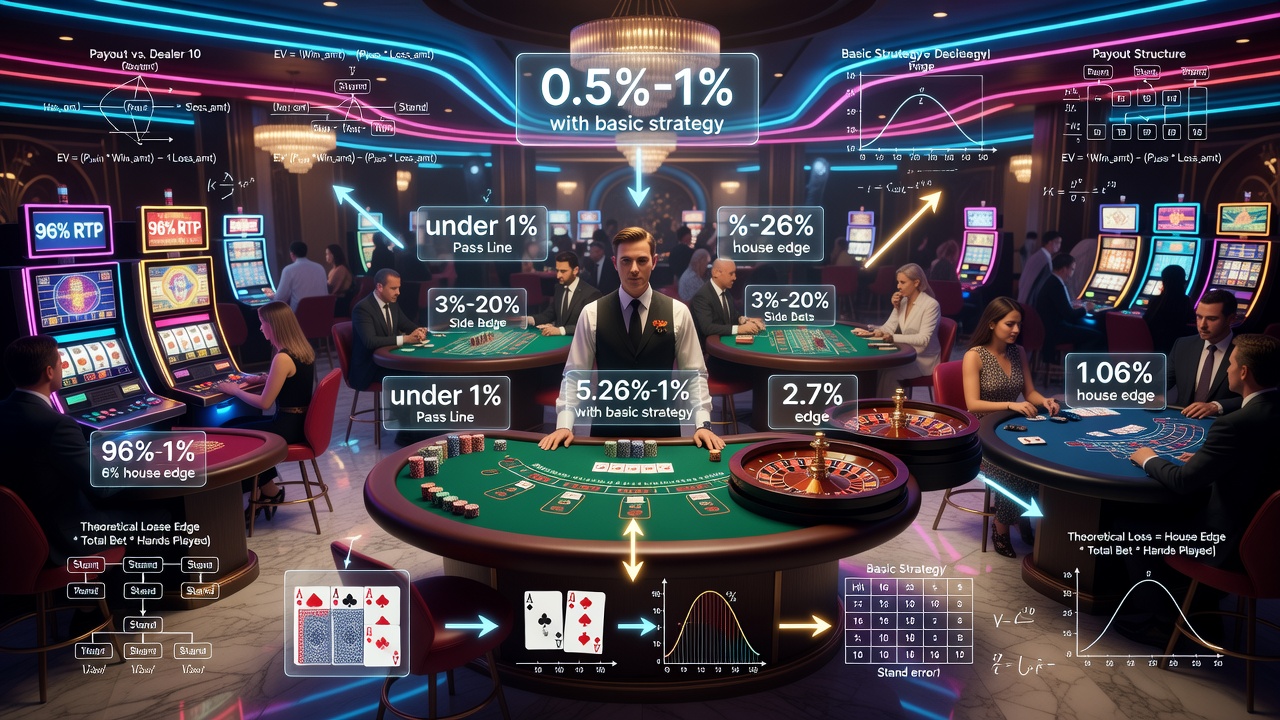
A blackjack table with a 0.5% house edge and a slot machine advertised as "96% RTP" are describing the same mathematical concept in two different dialects, and most players never realize it. That gap in translation costs gamblers money every single day, not because the games are rigged, but because the numbers are misunderstood. Once you strip away the marketing language, casino games reveal a hierarchy of risk that has almost nothing to do with how exciting they feel and everything to do with the math built into their rules.
Blackjack occupies a strange position in that hierarchy. It's simultaneously one of the fairest bets on the floor and one of the easiest to play badly. The house edge blackjack carries under optimal conditions can rival the payout structure of a coin flip, yet most people playing it right now are handing the casino a much larger cut than necessary simply because they don't know basic strategy. Understanding how blackjack stacks up against roulette, slots, and other table games - and why the comparison isn't as simple as looking at one printed percentage - gives you a real framework for deciding where your money goes. For a detailed breakdown of how blackjack house edge blackjack vs other casino games differ, this deep dive lays out the mechanics clearly.
What House Edge Actually Means
House edge is the mathematical advantage a casino holds over a player, expressed as a percentage of each bet that the house expects to keep over the long run. It is not a fee charged upfront, and it doesn't predict what happens in a single hand or spin. It describes the average outcome across thousands or millions of bets, smoothing out the wild swings of individual sessions into a predictable long-term return.
The Math Behind the Edge
Every casino game is built on a payout structure that pays out slightly less than the true odds of winning would justify. If a coin flip paid even money and had a 50/50 chance of landing either way, the house edge would be zero. Casinos never offer that. They pay out at odds that are just short of the true probability, and that shortfall is the house edge. In blackjack, it comes from rule structures - like the dealer winning all ties in a bust scenario - rather than from bad payout odds on winning hands.
Why It's Expressed as a Percentage
Percentages allow direct comparison across totally different games. A 1% house edge on blackjack and a 1% house edge on a hypothetical dice game mean the same thing financially: for every $100 wagered over time, the house expects to retain about $1. This is precisely why the metric matters so much when you compare casino game house edges - it strips away the surface differences and reveals the actual cost of play.
Theoretical vs. Actual Loss
Theoretical house edge assumes flawless play and infinite trials. Actual losses vary wildly in the short term because variance - the natural swing of luck - can push results far from the average in either direction over a single session. This is why a blackjack player can lose money on a night when the game's edge is lower than a slot machine's, and why one lucky slot spin can outperform a mathematically superior table game in the short run.
House Edge Blackjack: The Numbers Explained
The house edge blackjack carries is unusual because it's not fixed. It moves depending on the specific rules at the table and, more importantly, on how well the player executes strategy. This variability is the single most important thing to understand before comparing blackjack to anything else.
Standard House Edge With Basic Strategy
Under commonly used rule sets - six decks, dealer stands on soft 17, doubling after split allowed - a player using perfect basic strategy faces a house edge often falling between 0.5% and 1%. That range is exceptional compared to almost every other game on the casino floor. Basic strategy isn't guesswork; it's a set of mathematically derived decisions for every possible hand combination, and it's freely available for anyone willing to learn it.
How Table Rules Shift the Edge
Small rule differences carry real weight. A dealer hitting soft 17 instead of standing adds roughly 0.2% to the house edge. Blackjack paying 6-to-5 instead of the traditional 3-to-2 can inflate the edge by well over a full percentage point - enough to turn one of the best bets in the casino into a mediocre one. Number of decks, surrender options, and doubling restrictions all nudge the number up or down.
The Cost of Playing Without Strategy
Here's the part casinos rely on: most players don't use basic strategy. Deviating from it - standing too early, not doubling when the math says to, splitting the wrong pairs - can push the effective house edge to 2% or higher. The gap between a strategic player and an intuitive one is larger in blackjack than in almost any other game, because blackjack is one of the few games where player decisions genuinely change the outcome.
- 0.5%-1% edge with correct basic strategy under favorable rules
- 1.5%-2%+ edge for players making common strategic errors
- Additional edge increase from side bets like insurance or perfect pairs
Blackjack House Edge vs Roulette
Roulette offers a useful contrast because, unlike blackjack, no amount of skill changes the outcome. Once the ball is released, the result is pure chance, and the house edge is fixed regardless of how the player bets.
American vs European Roulette Edge
European roulette, with a single zero, carries a house edge of about 2.7%. American roulette, with both a single and a double zero, roughly doubles that to 5.26%. That extra pocket doesn't change any of the payouts - it simply adds another way for the house to win, which is why the American wheel is structurally worse for players regardless of betting pattern.
Why Betting Systems Don't Close the Gap
Martingale, Fibonacci, and other progressive betting systems are popular in roulette because the game feels like it should be beatable through pattern management. It isn't. No sequence of bet sizing changes the underlying probability of each spin, and the house edge remains constant no matter how the wager is structured. This is a core reason the blackjack house edge vs roulette comparison favors blackjack so heavily - skill has zero influence in one game and significant influence in the other.
Practical Implications for Players
A player who learns basic strategy can play blackjack at a fraction of roulette's cost. Someone wagering the same amount over the same number of hands will, on average, lose two to five times more at an American roulette wheel than at a well-chosen blackjack table. That doesn't make roulette a bad game to enjoy - it's simple, social, and fast - but it's not competitive on pure mathematics.
Blackjack House Edge vs Slots
Slot machines are the most misunderstood comparison point because their house edge is hidden behind the language of "return to player," or RTP, rather than stated directly.
Understanding RTP vs House Edge
RTP and house edge are inverses of each other. A slot with 94% RTP has a 6% house edge - meaning, over the long run, it returns 94 cents of every dollar wagered and keeps 6 cents. Most physical and online slots fall somewhere between 88% and 97% RTP, translating to a house edge ranging from roughly 3% to 12%. That's a wide spread, and it's rarely disclosed clearly on the machine itself.
Why Slots Feel Different Despite Worse Math
Slots use variable reward schedules, frequent small payouts, and fast spin cycles to create an experience that feels more rewarding than the math justifies. Blackjack house edge vs slots comparisons consistently show that slots cost players more per dollar wagered, yet slots remain the most popular casino game by volume because the entertainment value per bet is high and the required skill is zero.
Volatility and Session Length
Slots also carry higher volatility, meaning wins and losses swing more dramatically session to session. A blackjack player facing a 1% edge will see results cluster closer to that average over a night of play. A slot player facing an 8% edge might hit a jackpot that erases the math entirely for one lucky visit - or burn through a bankroll far faster than the average would suggest, because variance in slots is engineered to be extreme.
Blackjack vs Other Table Games House Edge
Beyond roulette and slots, the wider table game menu - baccarat, craps, three card poker, and similar games - creates a spectrum worth understanding before choosing where to sit down.
Baccarat and Craps Compared
Baccarat's banker bet carries a house edge around 1.06%, making it one of the closest competitors to blackjack in terms of pure mathematics, though it requires no strategic decisions at all. Craps offers similarly strong odds on specific bets - the pass line with full odds can bring the effective edge below 1%, sometimes even lower than blackjack depending on the odds multiple offered. Both games prove that low house edge doesn't always require skill; sometimes it's simply a function of well-structured payout odds.
Side Bets and Novelty Games
Three card poker, Caribbean stud, and various proposition bets scattered around craps and roulette tables often carry house edges between 3% and 20%. These games are marketed on entertainment and big-payout potential rather than favorable math, and they represent the opposite end of the spectrum from blackjack's strategy-driven, low-edge structure.
Where Blackjack Ranks Overall
When you line up the full menu, blackjack vs other table games house edge comparisons place blackjack near the top of the value list, competitive with baccarat and full-odds craps, and well ahead of roulette, three card poker, and virtually every slot machine. Its main requirement is effort - learning and applying strategy - which is a trade most casual gamblers skip.
How to Compare Casino Game House Edges
Reading a house edge number in isolation tells you little. Context matters as much as the figure itself.
Reading Posted Odds and RTP Correctly
Always check the specific rule variant before assuming a game's edge. Blackjack tables post their payout ratio and dealer rules somewhere visible; slots list RTP in their help screen or paytable. Comparing a 3-to-2 blackjack table to a 6-to-5 table, or a 96% RTP slot to an 88% one, produces wildly different real-world costs even though both pairs are technically "the same game."
Factoring in Skill Requirement
Games split into two categories: those where player decisions matter (blackjack, video poker, certain craps bets) and those where they don't (roulette, slots, baccarat). The former rewards study; the latter is purely a function of the posted odds. Knowing which category a game falls into tells you whether learning strategy is worth your time.
Weighing Edge Against Entertainment Value
The lowest house edge isn't automatically the "correct" choice. Bet size, session length, and personal enjoyment matter. A player who finds slots more entertaining per dollar spent may rationally choose them despite the worse math, provided they understand the actual cost of that entertainment rather than assuming it's comparable to blackjack or baccarat.
- Check the specific rule set or RTP before playing, not just the game's general reputation
- Prioritize skill-based games if you're willing to learn optimal strategy
- Treat house edge as a long-term average, not a prediction for your session
Frequently Asked Questions
Is blackjack really better odds than roulette every time?
Yes, assuming the player uses correct basic strategy and the blackjack table doesn't have unfavorable rules like 6-to-5 payouts. Against a standard European wheel's 2.7% edge or an American wheel's 5.26%, a well-played blackjack hand at 0.5%-1% is mathematically superior in nearly all cases.
Why do slots have such a high house edge compared to table games?
Slots require no skill and rely on licensing fees, bonus features, and elaborate graphics that cost money to produce, which the house edge helps offset. They also generate revenue through volume and frequent play rather than large individual wagers, so a higher edge per spin is built into the business model.
Does card counting eliminate the house edge in blackjack?
Skilled card counting can shift the edge slightly in the player's favor, sometimes by half a percent or more, by tracking high and low cards remaining in the shoe. It requires significant practice, and most casinos actively watch for and restrict players suspected of doing it.
Why do casinos allow blackjack if the house edge is so low?
Most players don't use perfect basic strategy, which raises the effective edge well above the theoretical minimum. Casinos also profit from volume, table minimums, and the fact that even a small consistent edge compounds significantly across thousands of hands dealt daily.
Is a lower house edge always the smarter bet?
Mathematically, yes, in terms of expected long-term loss, but short-term variance means a low-edge game can still produce a losing night while a high-edge slot could pay out a large jackpot. The house edge describes averages over large samples, not guarantees for any single session.
How much does the number of decks affect blackjack's house edge?
Fewer decks generally favor the player slightly, since single-deck blackjack tends to shave a small fraction of a percent off the house edge compared to six or eight-deck shoes. The difference is real but modest - often under 0.5% - and is usually outweighed by other rule variations like soft 17 or payout ratios.