
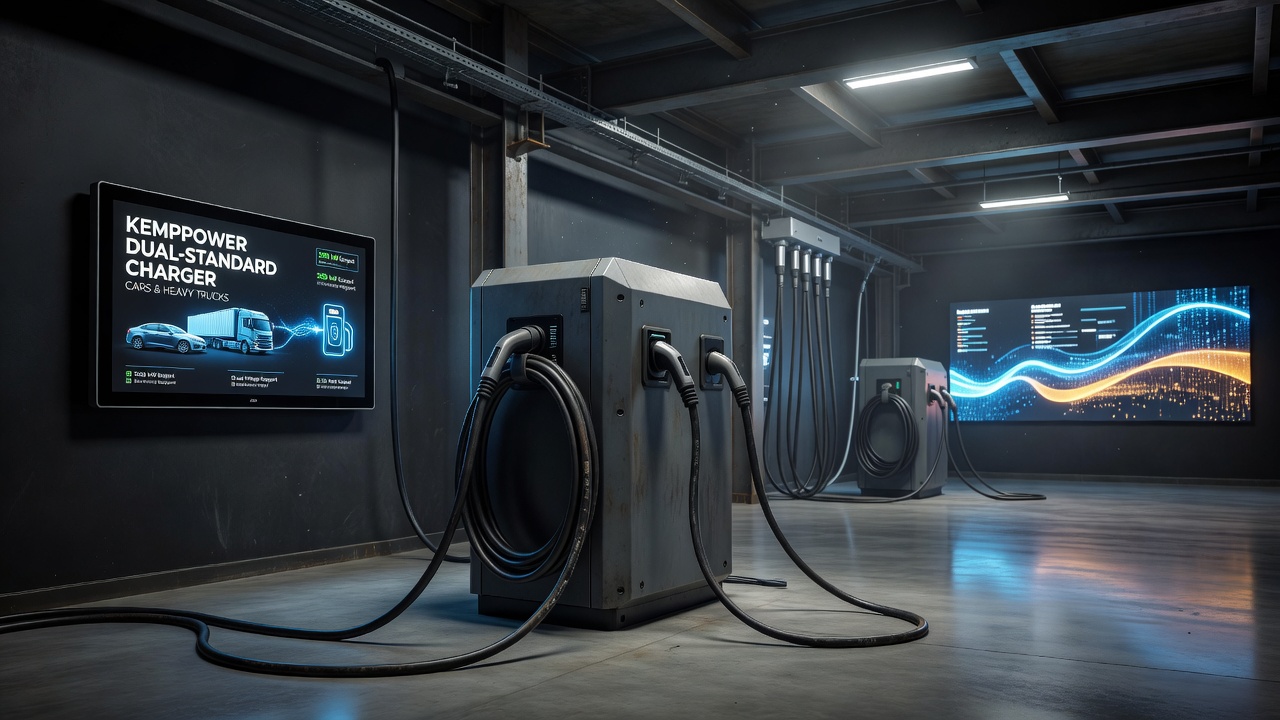
A single charging dispenser that can fuel a passenger car and a heavy-duty truck without swapping hardware is no longer a concept on a slide deck. Kempower has unveiled the Mega Satellite Flex, a high-power charger that supports both the established CCS standard, at up to 560 kW, and the emerging Megawatt Charging System, at up to 1.2 MW. The announcement came this week at ACT Expo, during the company's Unplug & Recharge event for customers and partners.
The timing reflects a genuine industry crossroads. CCS remains the dominant plug format for electric passenger vehicles across North America and Europe, while MCS is still being built out specifically for electric trucks and buses that demand far higher power to make long-haul routes economically viable. Rather than forcing site owners to choose one standard and commit to it, Kempower's approach lets a single piece of infrastructure serve both camps, and it's compatible with the company's existing distributed charging architecture, meaning operators won't need to tear out equipment to add it. For fleet managers who already juggle enough operational complexity - from route planning to contract terms, including figuring out how to cancel without losing access to software subscriptions tied to their charging management systems - that kind of backward compatibility matters as much as raw power output.
Why One Dispenser for Two Standards Matters
Building charging infrastructure is expensive, and land, grid connections, and permitting are often the real bottlenecks, not the hardware itself. A charging site designed only for passenger cars typically can't handle the current demands of a semi truck, and vice versa. Historically, that has meant operators pick a lane: serve cars now and hope to retrofit for trucks later, or build a truck-only corridor and leave passenger vehicles out. The Mega Satellite Flex is Kempower's attempt to remove that choice. A property owner can install one system that flexes between a sedan pulling in for a quick top-up and a freight truck requiring a much larger, faster charge, without a second construction project down the line.
The specifications back up the ambition. The unit handles up to 1,500 amps for MCS charging and 700 amps for CCS, with cable lengths of 5 meters for CCS and 2.7 meters for MCS. An optional payment terminal allows it to function as a public-facing charge point rather than a fleet-only asset. It's also built to take advantage of 800-volt vehicle architectures, an increasingly common design in newer EVs that allows for shorter charging sessions when paired with sufficiently powerful hardware.
What It Means for Operators and the Broader Transition
For companies operating charging sites, utilization is the metric that determines whether an investment pays off. A charger sitting idle for stretches of the day is a poor use of capital, particularly when megawatt-capable equipment carries a higher price tag than standard Level 3 units. By serving both passenger and heavy-duty vehicles from a single point, Kempower is betting that operators will see stronger day-one usage rates and a shorter path to profitability, especially in mixed-traffic locations like highway corridors and logistics hubs where cars and trucks pass through the same real estate.
The broader significance is about sequencing. MCS infrastructure is still young, and truck manufacturers, charging companies, and grid operators are effectively building the standard's real-world footprint in parallel with vehicle production. Dual-standard hardware like the Mega Satellite Flex reduces the risk of stranded investment on either side of that transition. The charger is expected to reach North America and Europe in July 2026, giving operators a defined window to plan sites that won't need a second buildout once heavy-duty electric trucks become a larger share of highway traffic.