
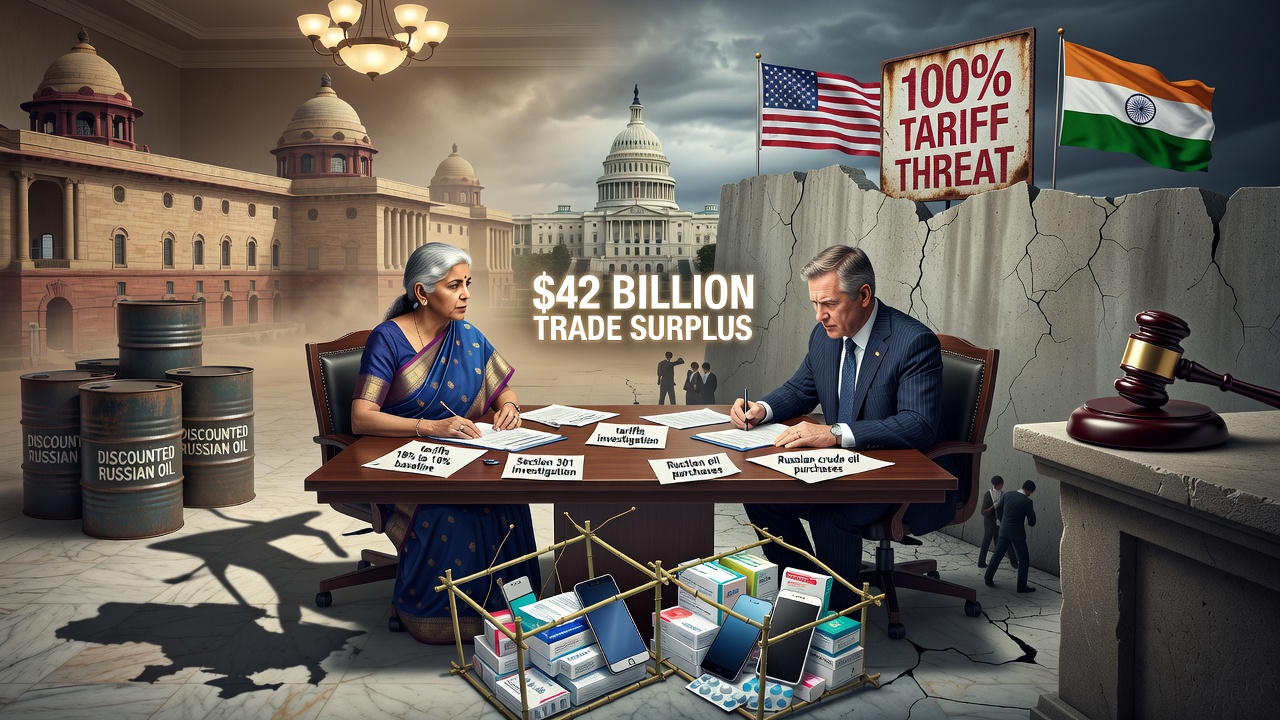
Negotiators in New Delhi and Washington have hit another wall. Finance Minister Nirmala Sitharaman described the talks as having reached a "plateau," while US Trade Representative Jamieson Greer said a deal is not "imminent" - language that confirms what trade watchers had already suspected: the long-promised bilateral agreement between the world's two largest economies remains out of reach, again.
A Fragile Framework Under Strain
The two countries had built momentum earlier this year. A February framework cut the punitive tariff on most Indian goods to 18% from the 50% rate imposed after an earlier round of talks broke down. A subsequent US Supreme Court ruling struck down President Trump's use of emergency powers for sweeping global tariffs, settling on a 10% baseline rate instead. That sequence looked like progress. But a durable, signed agreement has not followed, and neither government has offered a detailed public account of why.
Oil Purchases and an Unfinished Investigation
Two unresolved issues are doing most of the damage. The first is India's continued purchase of discounted Russian crude, which a new US law could penalize with tariffs of up to 100% on Indian goods. Washington argues these purchases help finance Russia's war in Ukraine; New Delhi counters that sourcing decisions reflect the energy needs of a population of 1.4 billion, and that Russian oil became attractive precisely because of price discounts following the invasion and subsequent Middle East disruptions. India has not significantly reduced these purchases.
The second complication is a US Section 301 investigation into alleged excess industrial capacity across several countries, examining whether overproduction is undercutting American industry. Until that probe concludes, nobody - including Indian officials - can say with certainty what final tariff rate Indian goods will face. That uncertainty itself discourages concessions on either side.
What's at Stake for Exporters and Markets
India's exports to the US have so far proven resilient, rising to $42.79 billion between April and August from $40.39 billion a year earlier, with India running a trade surplus of roughly $34 billion in fiscal 2025/26. Much of that strength comes from categories like generic pharmaceuticals and smartphones, which currently sit outside the 10% baseline levy. But that cushion is not guaranteed to last. Analysts warn that without a finalized deal, India remains exposed to tariff increases stemming from both the Section 301 probe and the Russian oil sanctions law, even allowing for the possibility of negotiated waivers. A fresh round of tariff hikes could dent business sentiment and pressure the rupee, which is already trading near record lows.
India, for its part, is trying to shield politically sensitive sectors - dairy, poultry, rice and wheat among them - from market-opening commitments, while pushing for tariff terms at least as favorable as those offered to competitors like Vietnam and China. It wants clarity on US tariffs before it offers further concessions, a reasonable negotiating position but one that keeps talks in a holding pattern.
Diplomacy Beyond the Trade Table
- Bilateral relations have been strained by separate incidents, including a US military strike on a ship off Oman that killed three Indian seafarers.
- India has publicly rejected President Trump's repeated claims of having brokered a ceasefire between India and Pakistan.
- Secretary of State Marco Rubio is expected to visit India later this month, potentially offering a venue for incremental progress.
- Modi and Trump spoke by phone on September 30 and are expected to speak again soon, with Modi likely to travel to the US in December for the G20 leaders' meeting.
None of these diplomatic touchpoints guarantees a breakthrough. But they underscore that the trade relationship is now entangled with broader geopolitical friction - energy policy, regional security claims, and competing strategic interests - making a quick resolution less likely than either side's earlier optimism suggested.