
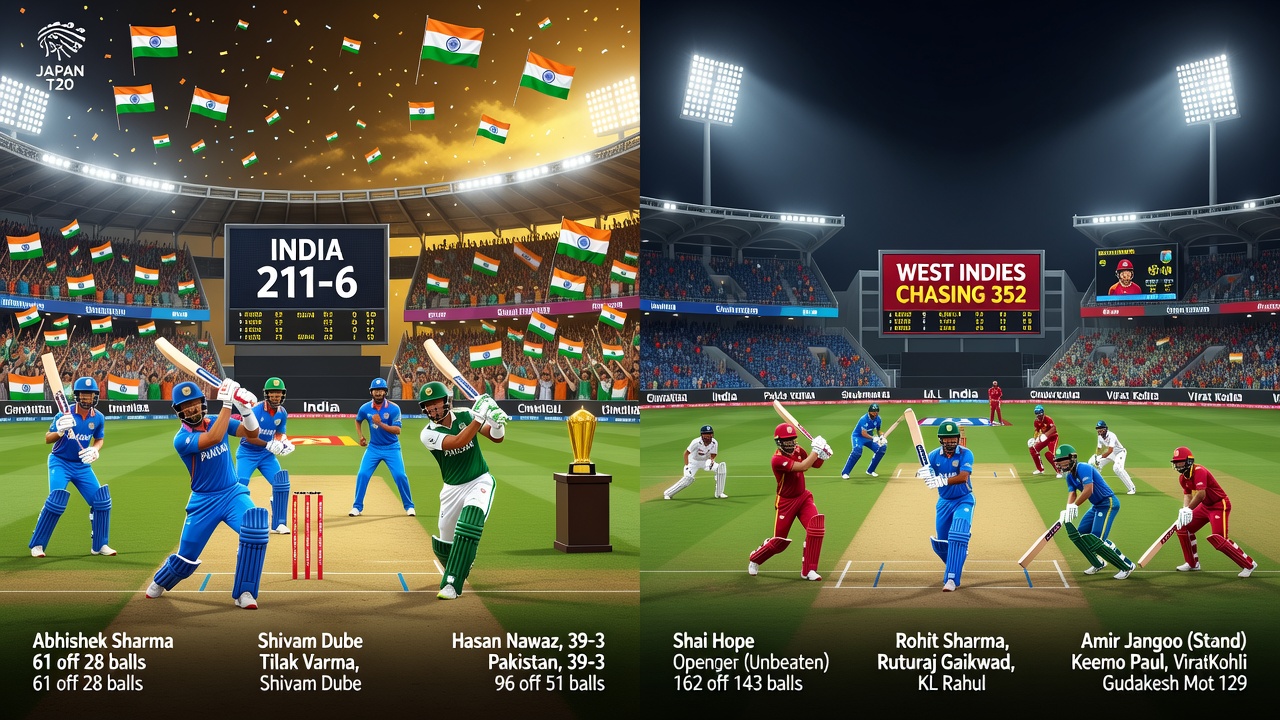
India claimed a second consecutive Asian Games gold medal in T20 cricket, beating Pakistan by 19 runs in Japan, but could not finish the day with a clean sweep. Hours later, in New Chandigarh, their one-day international side lost the dead-rubber third match against West Indies after Shai Hope struck an unbeaten 162 to complete the highest successful run chase in the fixture's history.
A dominant night in the Asian Games final
India posted 211-6 against Pakistan, built on Abhishek Sharma's rapid 61 off 28 balls, an unbeaten 51 from Tilak Varma and a brisk cameo from Shivam Dube. Pakistan never recovered from an early collapse to 39-3, and although Hasan Nawaz counterattacked with 96 off 51 deliveries, the chase fell well short. The result extended India's winning streak over Pakistan in T20 internationals to seven matches, and they have now won 14 of the 18 meetings between the sides in the format. Cricket has featured at every Asian Games since 2010 apart from the 2018 edition, and India has won gold at both tournaments in which it has competed, first in China in 2022 and now in Japan. The next Games are scheduled for Qatar in 2030.
West Indies chase down a record total
In the ODI series finale, India set West Indies 352 to win after half-centuries from Rohit Sharma, Ruturaj Gaikwad and an unbeaten 129 from KL Rahul steadied the innings following an early stumble to 4-2. Shubman Gill, fresh from an unbeaten 223 in the previous match, and Virat Kohli both fell in the same over without scoring, a reminder that even in a series already decided, individual form can swing sharply.
West Indies' chase rested almost entirely on Hope, who kept wicket for the full 50 overs before opening the batting and finishing on 162 not out from 143 balls. He added 109 with Amir Jangoo and later found support from Keemo Paul and Gudakesh Motie to get his side home with ten balls remaining. A contentious review, in which Sherfane Rutherford was given out caught behind despite disputing the Snicko reading, briefly threatened to disrupt the chase but ultimately had no bearing on the outcome.
Why these results matter beyond the scoreline
Results like these carry weight well beyond the scorecard. Record-breaking chases and high-profile India-Pakistan contests are among the most heavily traded events in global sports betting markets, and matches already stripped of series significance - such as a dead rubber - often still attract substantial wagering interest, particularly in in-play markets where totals shift rapidly. A 352-run target being chased down with overs to spare, or a side collapsing to 39-3 in a final, illustrates how quickly pre-match pricing can be overtaken by events, which is precisely why regulated betting operators emphasise live-odds transparency and clear settlement rules around contentious moments such as review decisions.
The Rutherford review also points to a broader issue in sports technology: decision-review systems like Snicko are widely trusted but not infallible, and disputed calls can directly affect settled bets as well as match outcomes. For consumers engaging with betting markets around cricket, understanding that odds reflect probability rather than certainty remains essential, especially in a sport where momentum can turn within a handful of overs.
What comes next
Attention now turns to a five-match T20 series between India and West Indies starting in Lucknow, with several Asian Games gold medallists, including Abhishek Sharma, Tilak Varma and 15-year-old Vaibhav Sooryavanshi, joining the squad. The quick turnaround between formats and tournaments keeps India's playing roster, and the betting markets built around them, in near-constant motion through the international calendar.