
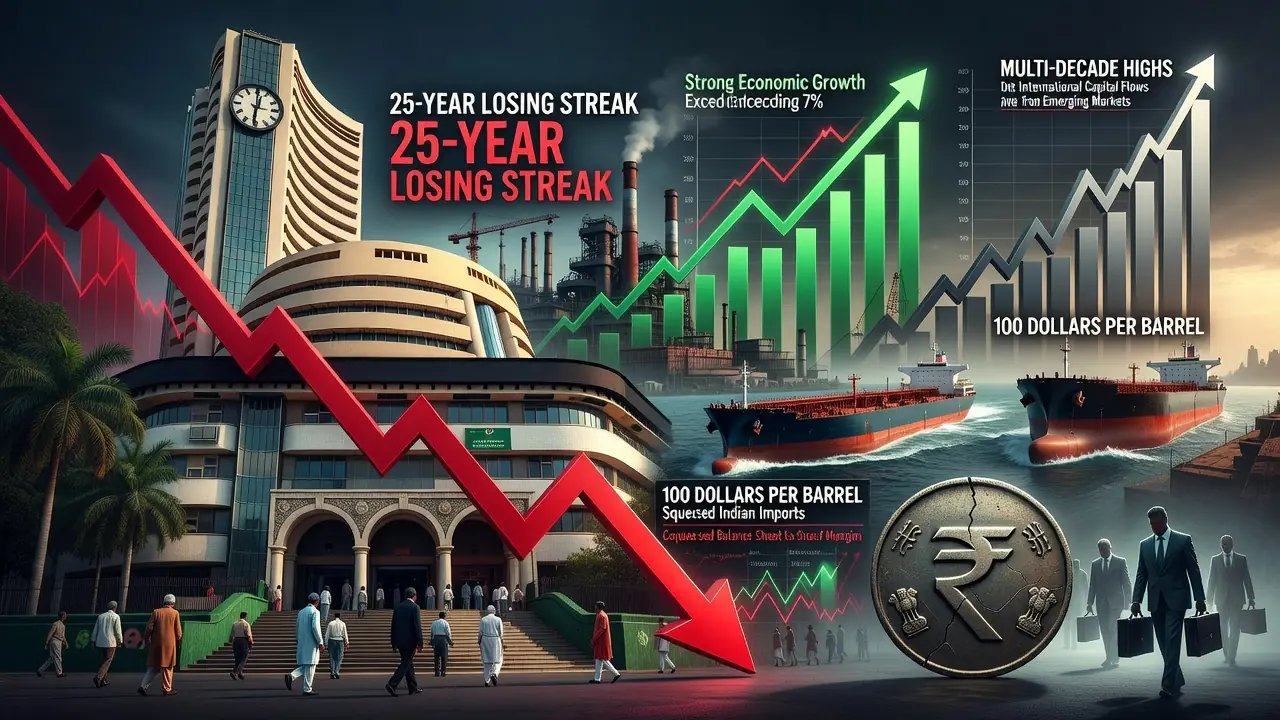
An economy expanding at more than 7% a year would normally produce a buoyant stock market. India's has not. The Sensex and Nifty indices, benchmarks for the country's largest listed companies, have just ended the longest losing streak in a quarter-century, and the disconnect between macroeconomic strength and equity performance has become one of the more puzzling stories in global markets this year.
Oil, rates and currency pressure converge
The gap begins with energy. Continued disruption to shipping through the Strait of Hormuz has kept crude oil prices elevated for far longer than most analysts expected, and India imports the overwhelming majority of its oil needs. Sustained prices above $100 a barrel squeeze both household inflation and corporate margins, a dynamic fund managers describe as one of the most reliable negative signals for Indian equities. Delhi's efforts to diversify supply, including purchases of Russian crude, have run into their own complications amid threatened US tariffs on countries trading with Moscow.
Layered on top of that is a global interest rate environment that favours safer assets. With US government bond yields near multi-decade highs, capital that might otherwise flow into emerging markets has less incentive to take on the additional risk of Indian equities. A weaker rupee compounds the problem for foreign investors, who measure returns in dollars rather than local currency, further dulling the appeal of Indian shares relative to other markets.
Valuations and the missing technology story
Indian stocks have become cheaper relative to their own history, narrowing the premium they once held over other emerging markets. But cheaper is not the same as cheap. Many of India's largest listed companies represent established industries rather than new growth sectors, and relatively little of the artificial intelligence investment boom that has lifted markets like South Korea and Taiwan has found its way into Indian corporate earnings. India has not yet produced a globally significant AI company of its own, and the smaller firms working in areas such as semiconductors, space and defence remain too limited in scale to shift broader investor sentiment.
Retail investors carry the weight
What has kept the market from falling further is domestic money. Mutual fund assets under management in India have grown sharply over the past decade, and the number of individuals investing in stocks and funds has more than tripled. That steady flow of retail capital has offset heavy withdrawals by foreign institutional investors, who have pulled tens of billions of dollars out of Indian markets over the past two years.
This reliance on domestic savers carries its own risk. Many of these investors are already contending with a soft job market, elevated living costs and weak consumption growth. Watching equity savings decline alongside those pressures adds a layer of financial stress that a purely macroeconomic reading of India's growth figures would miss. Whether retail investors continue committing fresh money through a deeper downturn, should one arrive, will likely determine how the next phase of this story unfolds.