
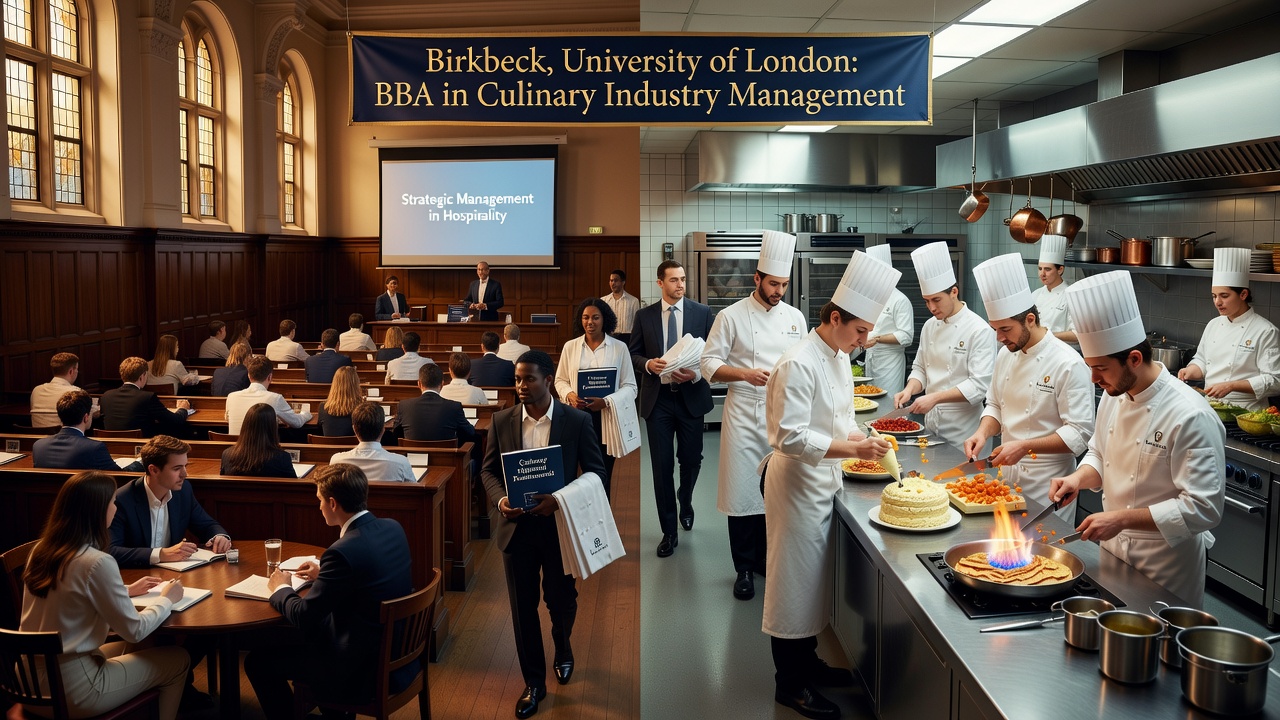
A new undergraduate pathway is bringing together two very different academic traditions under one qualification. Birkbeck, University of London, has partnered with Le Cordon Bleu Culinary Arts Institute to deliver a BBA in Culinary Industry Management, a course the two institutions describe as the only one of its kind in the UK. It sits at the intersection of professional kitchen training and formal business education, aimed at students who want to run food businesses rather than simply cook in them.
Two Institutions, One Qualification
The structure reflects the dual identity of the course. Business and management modules are taught at Birkbeck's Bloomsbury campus through lectures and small-group seminars, the standard format for a university business school. Culinary and professional practice modules are delivered separately at Le Cordon Bleu, using demonstrations, workshops and hands-on kitchen sessions led by trained chefs. Students typically attend two sessions at each institution weekly, moving between sites that are close enough to make this workable within a single timetable.
This split matters because it addresses a longstanding gap in hospitality education. Culinary schools have historically trained technical skill; business schools have taught management theory. Few programmes have tried to fuse the two into a single, examined degree with shared academic oversight, which is what makes this joint delivery model notable within the UK higher education landscape.
What the Timetable and Structure Actually Involve
The course runs full-time over three years, or four years for students who need a Foundation Year to prepare for degree-level study. Teaching takes place largely in the evening, between two and four days a week from October to July, which allows some students to work or manage other commitments alongside their studies. In the first year, culinary sessions at Le Cordon Bleu run from mid-afternoon into the evening, reflecting the practical nature of kitchen-based learning compared with a standard lecture slot.
- Entry requirements for the three-year route sit at 96-112 UCAS tariff points, roughly equivalent to BBC-CCC at A-level.
- The Foundation Year route requires 64 points and leads automatically into the main degree on successful completion.
- Applicants without traditional qualifications may still be considered, with decisions based on prior experience and a potential skills audit in English and mathematics.
- A summer internship between Years 1 and 2 is built into the course, giving students direct exposure to commercial food operations.
Assessment, Industry Links and What It Means for Graduates
Assessment is not limited to written coursework. Practical examinations form part of the culinary modules, alongside essays, case studies, presentations and a final research project, meaning students are judged on both technical competence and analytical ability. Guest speakers and visits to food service operations are built into the programme, giving students exposure to how commercial kitchens and hospitality businesses actually function beyond the classroom.
Both institutions are members of the Institute of Hospitality, and students on the course receive free membership, a modest but relevant professional credential in an industry where networks and recognised affiliations carry weight. For international applicants, the course qualifies for Student visa sponsorship when studied full-time, though those on a Student visa cannot switch to part-time study and should expect on-campus delivery rather than flexible or online formats.
The broader significance lies in what this signals about hospitality education generally. Food businesses increasingly need leaders who understand margins, staffing, compliance and brand management as much as technique. A qualification that formally examines both suggests the sector is adjusting its expectations of what a modern chef-manager needs to know, rather than assuming culinary skill alone is sufficient for business survival.