
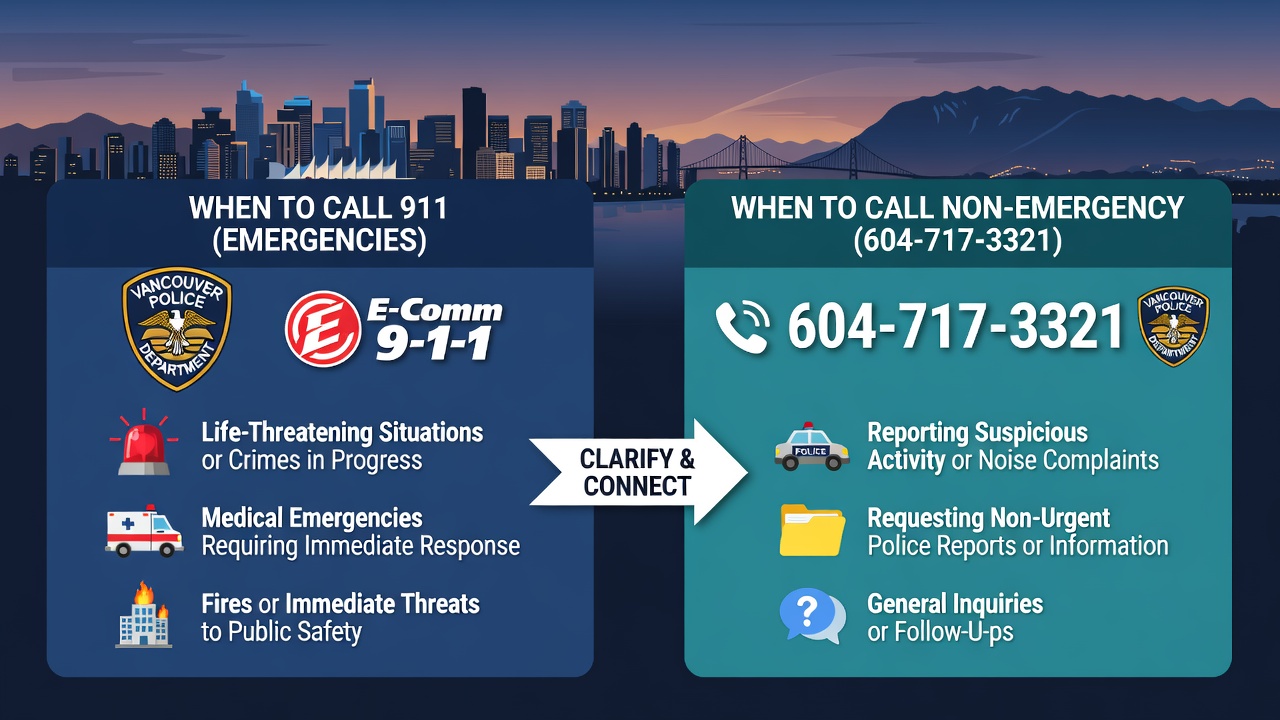
Knowing which phone number to dial during a crisis can matter as much as the response itself. The Vancouver Police Department, working through its dispatch partner E-Comm 9-1-1, has laid out clear guidance distinguishing true emergencies from incidents that belong on the non-emergency line. The distinction is not bureaucratic hair-splitting: it determines how quickly resources reach the people who need them most.
Why the Line Between 911 and Non-Emergency Matters
Emergency call centres are built to triage. A 911 call activates an immediate dispatch protocol for police, fire, or medical responders when lives are at risk or a crime is actively unfolding. Reserving that channel for genuine emergencies keeps response times short for people facing immediate danger. The VPD's non-emergency number, 604-717-3321, exists precisely so that less urgent matters - a break-in discovered the next morning, a noisy party, property lost without a suspect - do not compete with life-threatening calls for the same operators and dispatchers.
This structure reflects a broader pattern across North American policing: dual-track call systems reduce strain on emergency infrastructure while still ensuring every report gets logged and, where appropriate, investigated. Online reporting tools extend this further, allowing residents to file reports for lower-level, non-violent incidents - such as vandalism under $25,000 or a vehicle break-in - without tying up phone lines at all.
Accessibility and Specialized Response Options
Emergency systems have had to adapt to serve populations who cannot rely on a standard voice call. Text-to-911 (T911) allows Deaf, deafened, hard-of-hearing, or speech-impaired individuals to communicate with call centres through text messaging during an emergency. Critically, this service only functions if the phone is registered in advance and paired with an active voice call capability; an unregistered device attempting to text 911 without that setup will not get through. That technical limitation is worth understanding before an emergency occurs, not during one.
Other specialized pathways reflect similar reasoning. Missing person reports can be filed with no waiting period, but cases involving children, seniors, people with mental or physical health challenges, or anyone believed to be at risk of suicide are escalated straight to 911. Victim Services staff, trained in crisis intervention and trauma-informed communication, support people affected by intimate partner violence - abuse that is not always physical and does not always leave visible evidence.
Where Policing Ends and Other Agencies Begin
Not every problem that feels urgent is a police matter. The VPD's guidance routes several categories of concern elsewhere:
- Fraud without financial loss goes to the Canadian Anti-Fraud Centre; fraud over $10,000 within Vancouver becomes a police report.
- Minor motor vehicle collisions with no injuries and drivable vehicles are handled through ICBC claims.
- Tenancy disputes fall under the BC Residential Tenancy Branch.
- Non-immediate mental health concerns are directed to the BC Crisis Line or the national suicide prevention line, rather than police dispatch.
- Marine pollution reports go to the Canadian Coast Guard, and boat owners retain legal responsibility for seaworthiness and cleanup costs under federal transport rules.
This division of labour matters for public trust as much as efficiency. When police resources are reserved for genuine threats to life and active crimes, response times improve across the board - and residents who need a civil, administrative, or health-system solution get routed to the agency actually equipped to help them.
Anonymous Reporting and Property Recovery
For residents who want to share information without identifying themselves, Crime Stoppers offers an anonymous tip line and online portal, separate from both 911 and the non-emergency number. The VPD also operates a Property Office that stores found items, evidence, and recovered vehicles; unclaimed property is held for a defined period before unclaimed items proceed to public auction. These administrative functions rarely make headlines, but they represent the quieter, procedural backbone of how a municipal police force actually operates day to day - distinct from, yet dependent on, the same call-answering infrastructure that handles emergencies.