
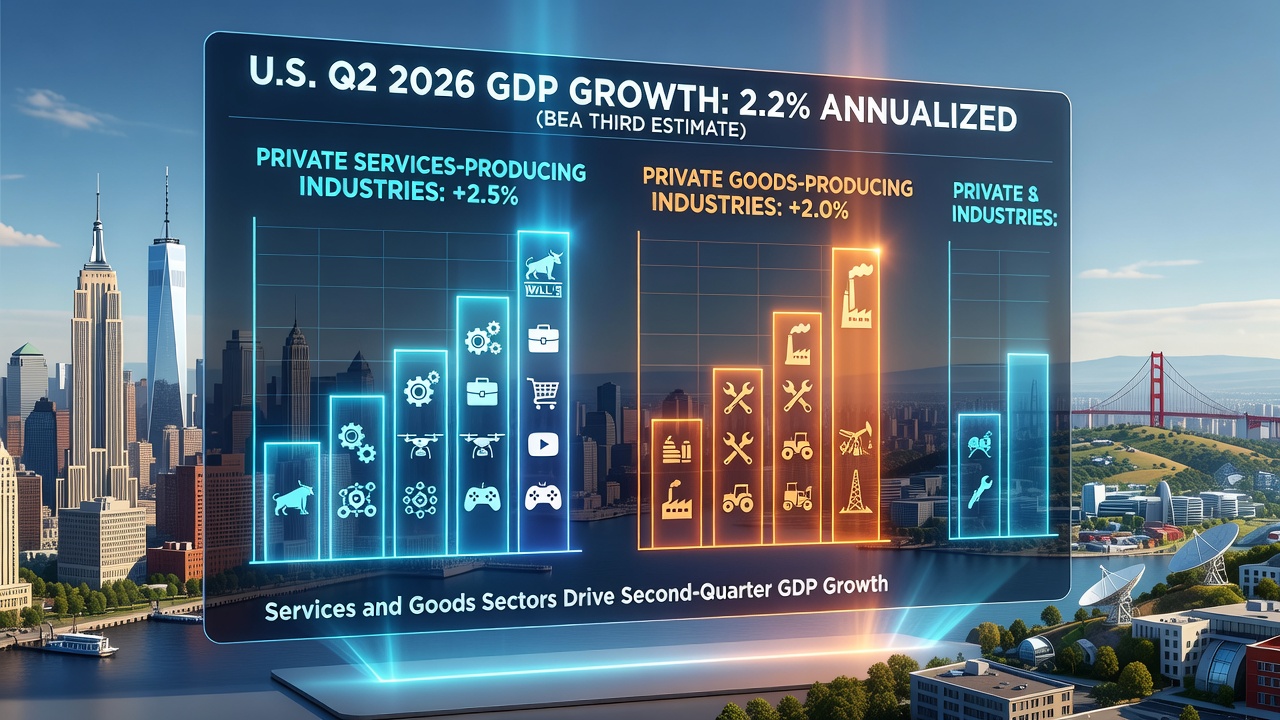
The U.S. economy expanded at an annual rate of 2.2 percent in the second quarter of 2026, according to the third estimate from the Bureau of Economic Analysis. The gain was broad-based rather than concentrated in a single corner of the economy: private services-producing industries added 2.5 percent in real value, private goods-producing industries grew 2.3 percent, and government contributed less than 0.1 percent. For an economy increasingly shaped by digital platforms, consumer services, and technology-driven commerce, the composition of that growth matters as much as the headline figure.
Why the Industry Breakdown Matters
Headline GDP figures tell you the economy grew. The industry-by-industry data, released alongside the third estimate each quarter, tells you where. This distinction is not academic. Services-producing industries - a category spanning finance, information technology, professional services, retail, and consumer entertainment - now represent the dominant share of economic activity in most advanced economies. When that segment outpaces goods production, as it did in this quarter, it often signals steady consumer spending on services rather than durable goods, along with continued expansion in digital and platform-based business models.
The BEA's industry accounts also break out compensation of employees, gross operating surplus, and taxes for each sector. That level of detail allows analysts to see not just how much an industry grew, but how the gains were distributed between wages, business profit, and public revenue - a distinction that matters for understanding labor market health versus corporate margin expansion.
What a Growing Services Sector Signals for Digital Industries
Private services growth of 2.5 percent is a meaningful number for industries built on digital consumption - streaming, online commerce, financial technology, and interactive entertainment among them. These sectors are classified within services-producing industries, and their performance tends to track broader consumer confidence and discretionary spending patterns. A services sector expanding faster than goods production generally reflects consumers directing more of their spending toward subscriptions, digital platforms, and experience-based purchases rather than physical products.
That pattern has downstream effects on regulated digital markets, including online gaming and entertainment platforms, where revenue is closely tied to consumer discretionary income. Stronger services growth does not guarantee stronger spending in any single subsector, but it does indicate the broader economic environment in which these businesses operate remains expansionary rather than contractionary.
The Limited Role of Government in This Quarter's Growth
Government value added grew by less than 0.1 percent, effectively flat. In an economy where public spending often acts as a counterweight during slowdowns, a near-stagnant government contribution alongside solid private-sector growth suggests the expansion was driven by private demand rather than public stimulus. For businesses and regulators alike, that distinction shapes expectations about fiscal policy, public investment, and the sustainability of growth going forward.
Reading GDP Data With Context, Not Assumptions
Quarterly GDP figures are frequently revised, and the third estimate incorporates more complete source data than the advance and second estimates that preceded it. Analysts, investors, and industry observers typically treat the third estimate as the most reliable of the three, though it remains subject to the BEA's broader annual revision cycle. Understanding GDP by industry requires resisting the temptation to draw conclusions from a single quarter. One period of services-sector strength does not establish a trend, and sector-level volatility is common from quarter to quarter.
- Private services-producing industries: +2.5 percent
- Private goods-producing industries: +2.3 percent
- Government: less than +0.1 percent
- Overall real GDP growth: 2.2 percent annualized