
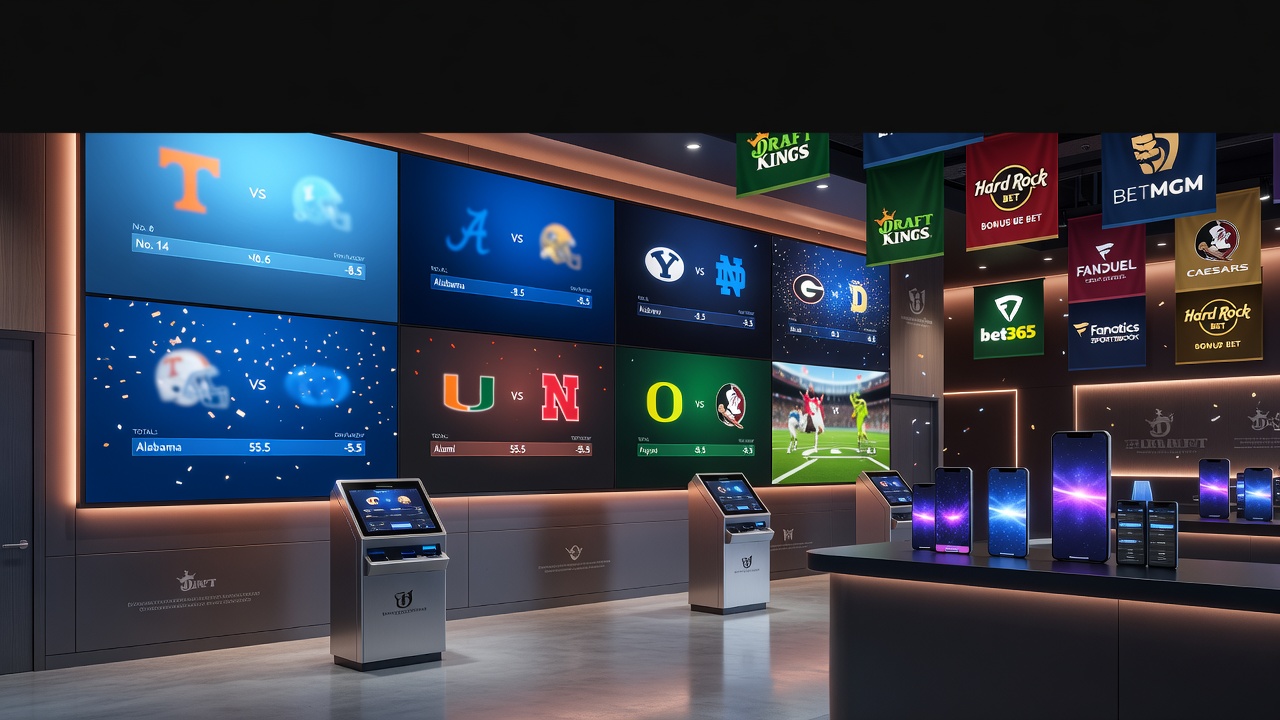
Six ranked matchups headline a Week 7 college football slate that has turned into a marquee weekend for the legal sports betting industry. Georgia's rise to the top of the rankings after beating Alabama, paired with marquee games like No. 14 Tennessee against No. 6 Alabama and No. 8 BYU against No. 2 Notre Dame, gives operators a high-visibility stage to compete for new customers. The timing also reflects how deeply sportsbook marketing has become woven into the broader college football viewing experience.
Why College Football Drives So Much Promotional Activity
College football's compressed, Saturday-heavy schedule creates a predictable surge in betting interest that sportsbooks can plan marketing campaigns around. Unlike the NFL, where games spread across the week, college football concentrates attention into a single day with dozens of ranked and unranked matchups, giving operators a wide menu of markets - moneylines, spreads, totals and props - to advertise simultaneously. That concentration makes the sport a natural vehicle for new-user promotions, since sportsbooks know a large audience will already be tuned in and comparing odds across games like Oregon-Nebraska or Miami-Florida State.
The promotional offers tied to this weekend's games, including bonus bets tied to a qualifying wager, are standard customer-acquisition tools used across the legal market. These offers typically require a minimum deposit or bet before bonus funds are released, and the value of any promotion depends on the terms attached, including rollover requirements and expiration windows. They are not a mechanism for guaranteed returns; they are a cost operators absorb to compete for market share in a crowded field that now includes DraftKings, FanDuel, BetMGM, Caesars, bet365, Fanatics Sportsbook and Hard Rock Bet.
The Regulatory Backdrop Shaping These Offers
Legal sports betting now operates in more than 30 states plus Washington, D.C. and Puerto Rico, a landscape built state by state since the 2018 Supreme Court decision that opened the door to legalization beyond Nevada. Each jurisdiction sets its own rules on advertising, bonus structures and consumer disclosures, which is why promotional terms can vary meaningfully depending on where a bettor is located. Regulators in several states have tightened scrutiny of how bonus offers are marketed, particularly around clarity on wagering requirements and the use of language that could overstate the value of a promotion.
This regulatory patchwork means consumers should read terms carefully rather than assume uniform rules apply nationally. A bonus bet structure in one state may carry different rollover conditions than the same-named promotion in another, and not all states permit identical formats.
What Bettors Should Weigh Beyond the Lines
Point spreads like Alabama's 8.5-point favorite status over Tennessee, or Notre Dame's 10-point line against BYU, reflect oddsmakers' efforts to balance betting action, not predictions of certainty. Over/under totals, such as the 55.5 points set for Miami-Florida State, function the same way. These numbers shift based on where money is flowing and new information, such as injuries, right up to kickoff.
- Bonus bets and sign-up offers carry terms that affect their real value, including minimum odds and time limits.
- Spreads and totals are market-driven tools, not forecasts of game outcomes.
- State-level rules on betting advertising and consumer protection vary and continue to evolve.
- Responsible gambling resources, including deposit limits and self-exclusion tools, are available through all licensed operators.
As the college football season approaches its midpoint, the volume of promotional activity is likely to continue tracking the calendar's biggest game days. For consumers, that means more offers to evaluate - and more reason to treat each one as a marketing instrument with defined terms, not a shortcut to profit.