
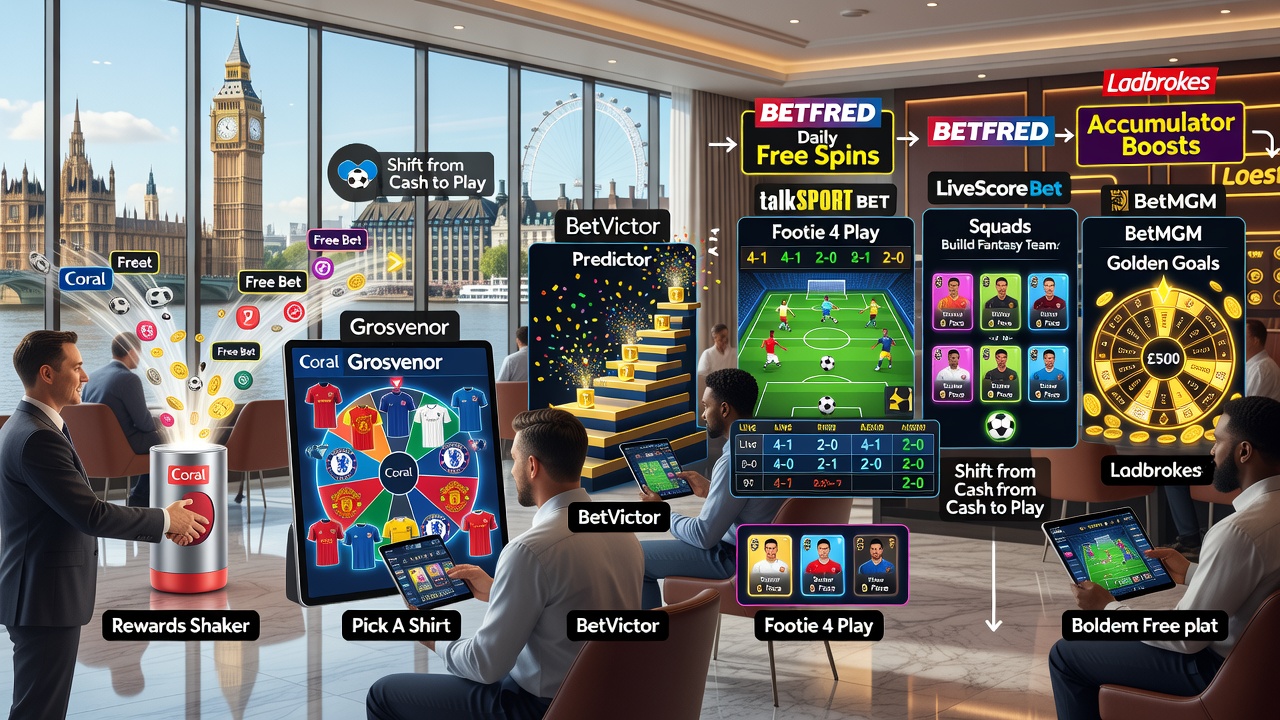
Genuine no-deposit free bets have all but disappeared from the UK betting market, not because operators stopped wanting to reward customers, but because marketing rules around pay-to-open incentives make simple giveaways harder to run. In their place, several major bookmakers have built free-to-play games that let existing, verified customers win free bets, cash or boosts without depositing a penny or placing a qualifying wager.
How the model actually works
Coral, Grosvenor, BetVictor, talkSPORT BET, Betfred, LiveScore Bet, BetMGM and Ladbrokes all run some version of this approach. Coral's Rewards Shaker is used daily and always returns something, whether that's a small cash sum, a free bet or an exclusive offer, while its Football and Racing Super Series reward correct predictions with shares of a prize pool. BetVictor Predictor and talkSPORT's Footie 4 Play follow a similar structure: predict scores correctly, climb a tiered reward ladder, with the top prize reserved for a perfect round. Grosvenor's Pick A Shirt and LiveScore Bet's Squads take a different format, built around mystery reveals and fantasy-style squad building, but the underlying principle is identical. None of these require a deposit. A logged-in, verified account is the only barrier to entry.
This is a meaningfully different product from a traditional free bet, which is typically issued as compensation for a losing wager or unlocked only after a customer stakes their own money first, as with bet-and-get promotions. No-deposit rewards earned through free-to-play games remove that financial commitment entirely, which is precisely why regulators treat them differently in a marketing context.
The fine print that determines real value
Free does not mean unconditional. These games carry structural limits that materially affect what a reward is actually worth:
- Entry caps: most games allow one entry and one prize per customer per day or round, and using multiple accounts to get around this breaches operator terms.
- Short expiry windows: rewards from these games commonly expire within three to seven days, considerably tighter than many sign-up offers.
- Minimum odds requirements: talkSPORT BET, for instance, requires free bets to be used at odds of at least evens.
- Market restrictions: not every free bet can be applied wherever a customer likes, and some exclude specific markets entirely.
- Conditional prize pools: games like BetMGM's Golden Goals can be voided in full if a selected fixture is postponed or abandoned, regardless of how well a player predicted the other matches.
Promotions are also often time-limited or require an opt-in, as with Grosvenor's Pick A Shirt, so an account being verified does not automatically guarantee eligibility.
What this means for customers and the wider market
The shift toward free-to-play mechanics reflects a broader pattern in UK gambling marketing: operators are increasingly required to demonstrate that promotional value is earned through engagement rather than simply handed out as an inducement to spend. For customers, that means slightly more effort is required to access a reward, but also that the offer itself carries no financial risk beyond the time spent entering. These games should still be treated as entertainment extras rather than a reliable source of winnings. Prize pools, when shared among multiple correct entries, can be modest in practice even when headline figures look substantial, and any gambling activity carries the same underlying risks regardless of whether money changed hands to enter. Anyone finding themselves chasing these games compulsively, or treating them as a source of income, should consider the self-exclusion and account-limit tools that all licensed UK operators are required to provide.