
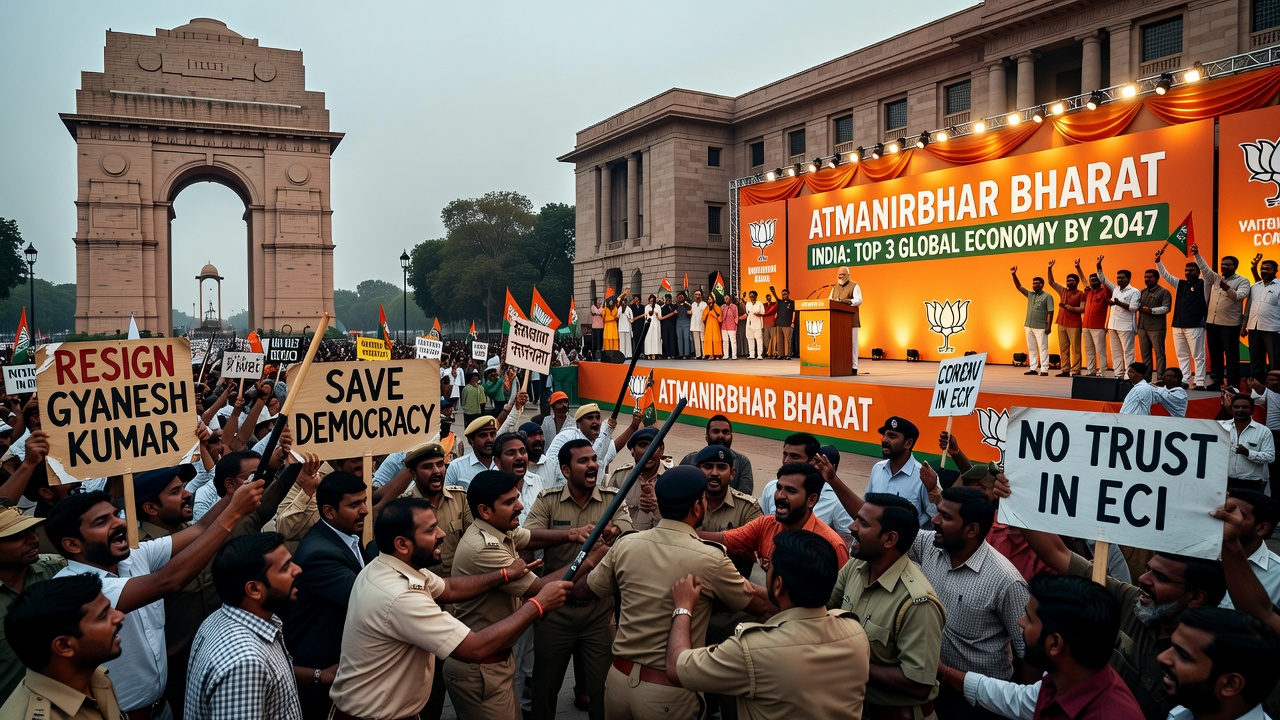
Police in New Delhi detained opposition leaders for a second straight day as protests demanding the resignation of Chief Election Commissioner Gyanesh Kumar continued to escalate. The demonstrations unfolded in parallel with Prime Minister Narendra Modi's commemoration of 25 years as an elected head of government, a span covering his years as Gujarat Chief Minister and his current tenure in New Delhi. The timing has sharpened the contrast between a government celebrating institutional continuity and an opposition questioning the independence of one of India's most consequential regulatory bodies.
A Clash Over Institutional Trust
The Election Commission occupies a position in India's democratic architecture comparable to that of a central regulator in any high-stakes sector: its credibility rests not on the outcomes it produces but on public confidence in its neutrality. Opposition parties have framed their demand for the Chief Election Commissioner's resignation as a matter of preserving that neutrality, arguing that unresolved questions about the Commission's conduct threaten the perceived fairness of electoral processes. The government has not offered a public concession on this point, and the repeated detentions of protesting leaders suggest an unwillingness to let the dispute play out visibly on the streets of the capital.
Modi's Milestone and the Viksit Bharat Agenda
At the Viksit Bharat Sankalp Sabha, organized by the Bharatiya Janata Party, the Prime Minister used the quarter-century marker to restate ambitions tied to the Atmanirbhar Bharat framework, including the goal of positioning India among the world's top three economies. Political analysts reviewing his record pointed to measurable gains in rural electrification and the expansion of welfare delivery mechanisms as pillars of that narrative. These achievements are frequently cited by supporters as evidence of administrative continuity and delivery capacity across two decades of executive leadership at state and national levels.
Critics, however, argue that economic messaging cannot be separated from concerns about democratic process. The juxtaposition of a triumphant political celebration with opposition leaders being taken into custody for peaceful protest has become, in itself, a point of contention - raising questions about proportionality in how dissent is managed during politically sensitive weeks.
Karnataka's Drought and the Limits of Welfare Delivery
Away from the capital, the Karnataka government's declaration of 217 drought-affected taluks illustrates the practical strain on welfare and compensation systems that political rhetoric often glosses over. Central assessment teams have been dispatched to districts including Tumakuru and Dharwad to evaluate crop losses, a process that determines the scale of financial relief farmers eventually receive. These assessments are rarely swift, and the gap between a drought declaration and disbursed compensation can leave agrarian communities exposed for months.
The Karnataka situation underscores a recurring tension in Indian governance: the distance between headline economic ambitions and the ground-level responsiveness of relief mechanisms. Farmers demanding compensation are, in effect, testing whether the administrative systems lauded in national speeches function with equal efficiency at the district level, where monsoon deficits translate directly into household income losses.
Why the Two Stories Are Connected
Though separate in substance, the Delhi protests and the Karnataka drought both center on institutional credibility - one concerning electoral oversight, the other concerning the state's capacity to respond to economic distress. Both tests arrive as the government presents a consolidated narrative of 25 years of governance achievement. How authorities handle detentions in the capital and how quickly compensation reaches drought-hit farmers will shape public perception of that narrative far more than any anniversary celebration.