
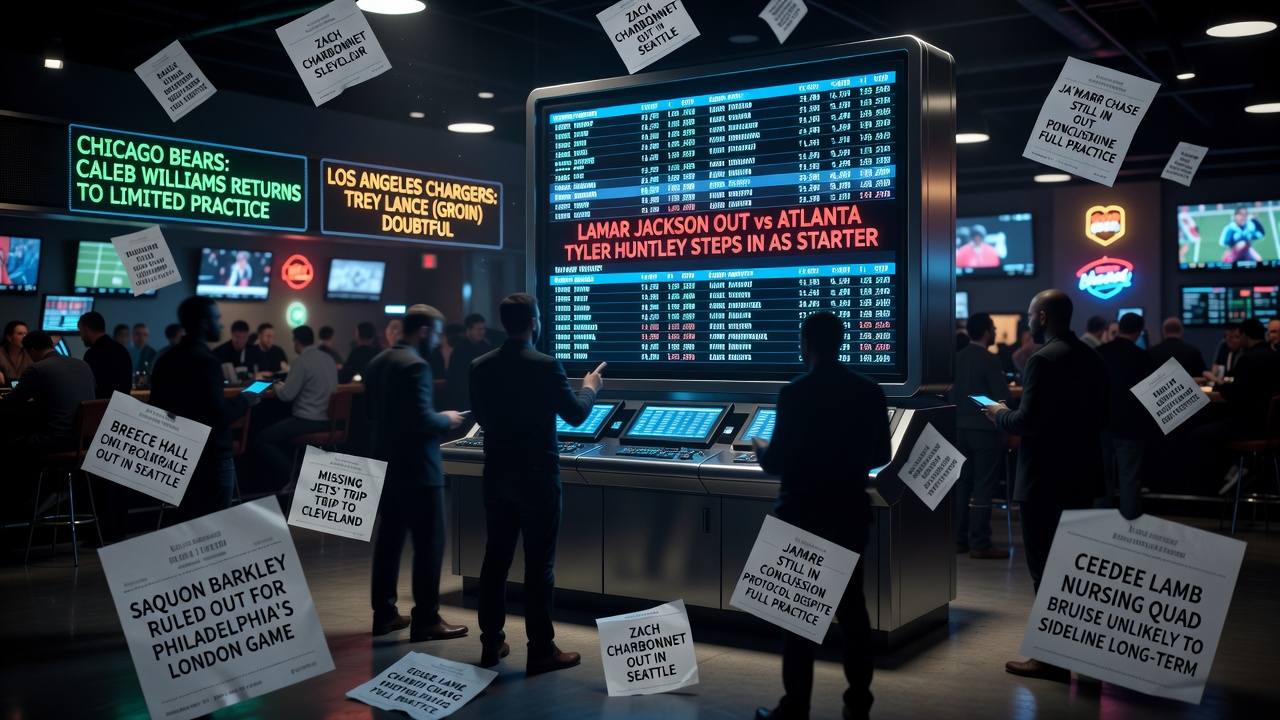
Lamar Jackson will not play Sunday night against Atlanta, and that single line item carries more weight for oddsmakers than almost anything else on this week's slate. Across the league, a dense cluster of questionable and doubtful tags at quarterback, running back and offensive line is forcing sportsbooks to move numbers quickly, and it illustrates how injury disclosure has become a load-bearing part of the modern betting ecosystem.
Why Injury Reports Move Markets
The NFL's official injury report exists primarily for competitive transparency, but it has become inseparable from the betting market. When a team confirms a starting quarterback is out, as Baltimore did with Jackson, lines react within minutes because the backup, Tyler Huntley, changes the statistical profile of an entire offense. Similar dynamics are playing out in Chicago, where Caleb Williams returned to limited practice after missing two games, and in Los Angeles, where Trey Lance's doubtful groin designation complicates an already difficult season for the Chargers. Sportsbooks price these announcements almost instantly, which is why odds can shift meaningfully between the release of a Friday injury report and kickoff.
Skill Positions Carry Outsized Weight
Running backs and receivers dominate this week's list, and their absences ripple differently than those of linemen or depth defenders. Saquon Barkley sitting out for Philadelphia in London, Breece Hall missing the Jets' trip to Cleveland, and Zach Charbonnet being ruled out in Seattle each remove a primary rushing option that bettors and bookmakers weigh heavily in game totals and spreads. Receiver uncertainty adds another layer: Ja'Marr Chase remains in the concussion protocol process even as he practices fully, a reminder that "questionable" does not always mean minor. CeeDee Lamb's quad bruise, by contrast, appears unlikely to affect Dallas beyond this week, underscoring that not every designation signals real risk to availability.
What This Means for Bettors and the Industry
For consumers, the lesson is less about chasing late-breaking news and more about understanding how incomplete information is priced into markets. Operators build injury uncertainty into their models well before official confirmation, which means a line rarely reflects a single secret advantage for anyone refreshing a team's practice report. The broader implication touches consumer protection as well: as injury news increasingly drives same-day betting activity, regulators and operators alike have reinforced that in-game and pre-game wagering should be treated as entertainment tied to genuine uncertainty, not a predictable system for profit. No amount of roster insight eliminates the structural uncertainty built into football, and responsible platforms continue to frame these fluctuations as part of a volatile, unscripted sport rather than an edge to be exploited.
- Confirmed starting quarterback absences (Jackson, Lance) typically produce the sharpest line movement.
- Skill-position injuries affect totals and spreads more directly than most defensive or offensive-line designations.
- "Questionable" tags vary widely in real risk, from protocol-related absences to minor bruises expected to clear quickly.