
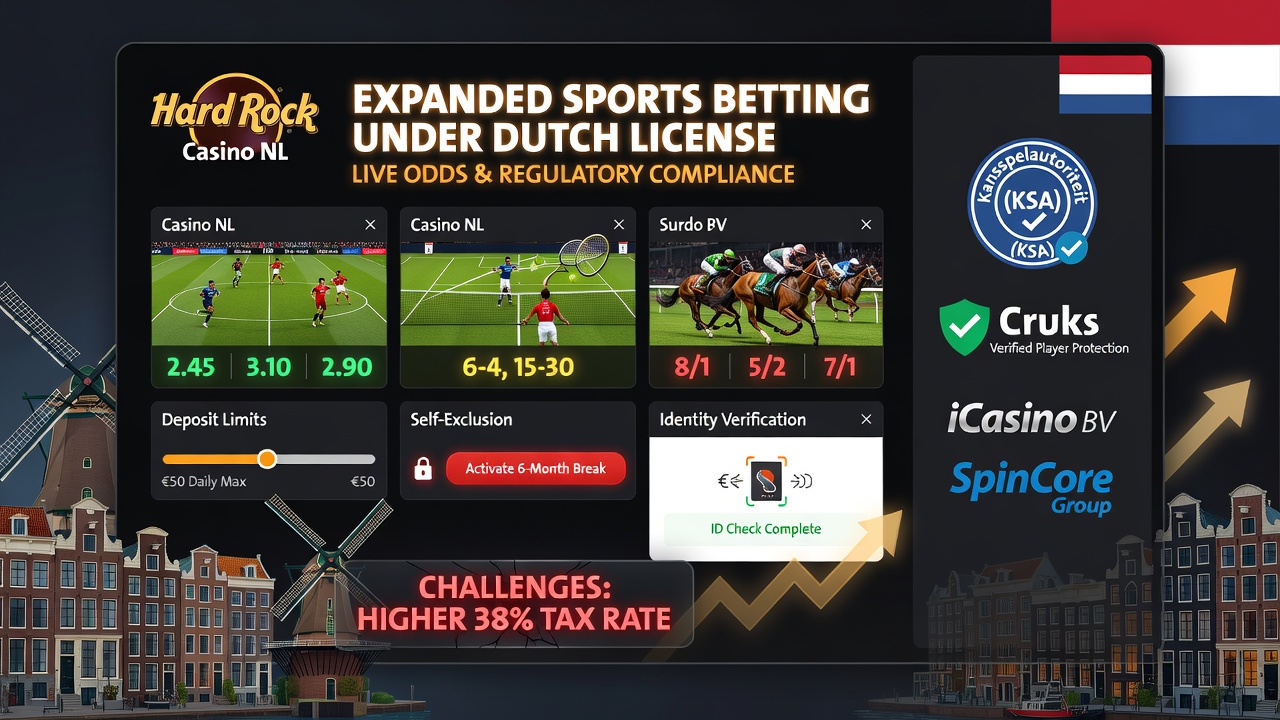
Hard Rock Casino NL has secured regulatory approval to launch sports betting in the Netherlands, expanding beyond the online casino products it has offered since the country's regulated market opened. The approval, confirmed on October 12, 2026, was granted by the Kansspelautoriteit (KSA) to iCasino BV, the locally licensed entity that operates the brand's Dutch website. The news was announced by SpinCore Group, the Malta-based operator behind Hard Rock Casino NL, via LinkedIn rather than a formal press release.
A Separate Entity From the Global Hard Rock Name
One detail matters for anyone trying to place this announcement in context: SpinCore Group, which operates exclusively in the Dutch market, has no corporate relationship with Hard Rock Digital, the international betting and gaming arm of Hard Rock International. The two companies share a brand license but operate independently, with different ownership, management, and regulatory footprints. This kind of licensing arrangement is common in gambling, where a globally recognized name is used by regionally focused operators under separate corporate structures. For Dutch consumers, the practical implication is that iCasino BV, not a multinational gaming group, is the licensed entity responsible for compliance, player protection, and product offering in the Netherlands.
Why the Timing Matters
The approval lands at a sensitive moment for the Dutch regulated market. The KSA has just completed renewal of the first wave of licenses issued when the market opened in 2021, covering major names such as TOTO Online, Holland Casino, bet365, BetCity, Bingoal, FairPlay Casino, Play North, and GG Poker. License renewal cycles are a routine but consequential part of regulated gambling markets: they give authorities a formal checkpoint to assess whether operators have met advertising restrictions, player protection obligations, and financial reporting standards before permission to continue operating is extended.
At the same time, the Dutch government has raised the gross gaming revenue tax to 38.7%, a significant increase that squeezes operator margins and can influence pricing, promotional spending, and product strategy. Combined with moves toward a full ban on gambling advertising, these pressures have contributed to an estimated channelization rate of 49% in 2025 - meaning roughly half of Dutch gambling activity is still believed to occur outside the regulated, licensed market.
The Channelization Problem
Channelization rate is the key metric regulators use to judge whether a licensed market is actually working. A rate near 50% suggests that licensing, taxation, and advertising policy have not yet succeeded in pulling the majority of gambling activity into the supervised system, where player protections, anti-money-laundering checks, and responsible gambling tools actually apply. Operators entering or expanding in this environment, such as Hard Rock Casino NL with its new sports betting product, are adding a regulated option at a time when the broader market structure is still being recalibrated by tax policy and advertising law.
- Higher taxation can push operators toward tighter margins on odds and promotions.
- Advertising restrictions limit how new products, including sports betting, can be marketed to Dutch consumers.
- A sub-50% channelization rate signals ongoing competition from unlicensed operators outside KSA oversight.
What It Means for Players
For consumers, the expansion means another licensed option for sports betting within a market that enforces identity verification, deposit limits, and self-exclusion tools through the national Cruks register. That regulatory layer is the primary practical difference between licensed platforms and unregulated alternatives operating outside Dutch oversight. As the KSA tightens advertising rules and adjusts tax policy, the coming year will show whether operators like Hard Rock Casino NL can grow within a shrinking promotional space while the government continues trying to narrow the gap between licensed and unlicensed gambling activity.