
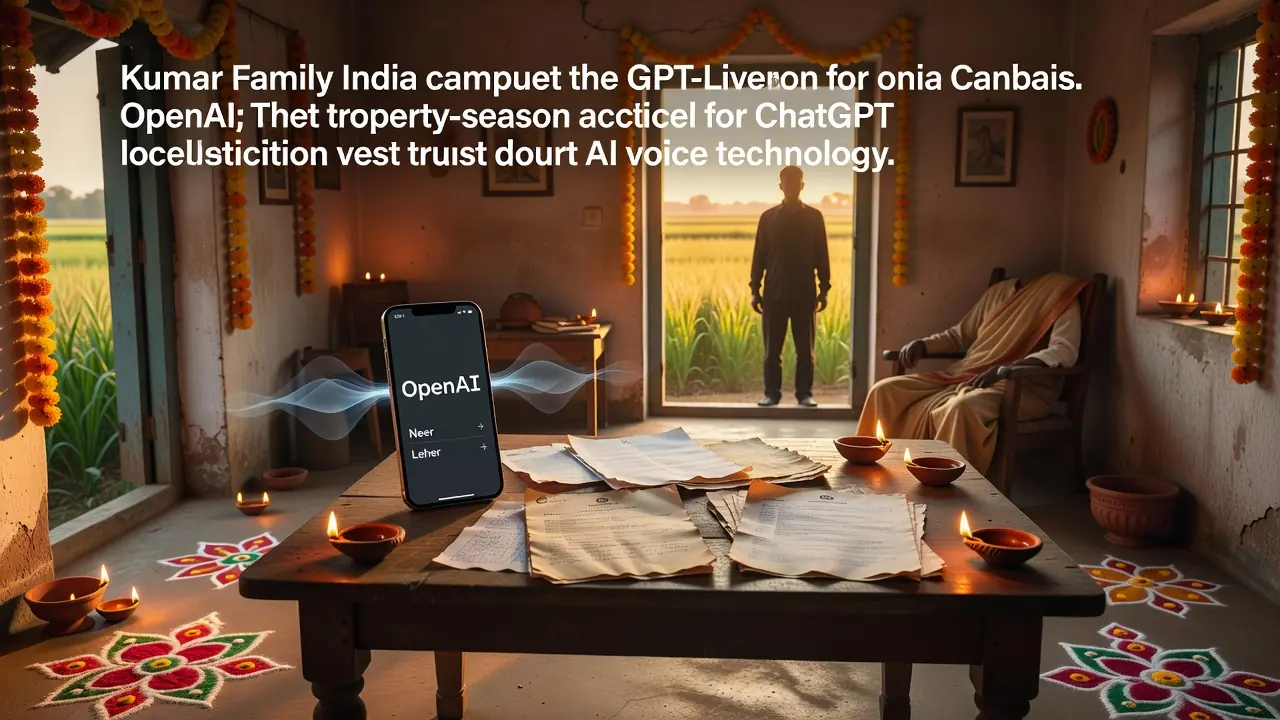
OpenAI has rolled out a festive-season campaign in India built around two new Hindi voice options for ChatGPT, named Neer and Leher. The voices arrive through GPT-Live-1.1, the latest update to ChatGPT's voice capability, and are being introduced not through a product sheet but through short films depicting an Indian family navigating everyday pressures. The approach signals a broader shift in how AI companies are trying to localise their products for a market where language, trust, and relatability matter as much as raw capability.
A Product Launch Framed as a Family Drama
The centrepiece film, The Notice, follows the Kumar family as they face a property developer's claim over their ancestral house and farmland. Rather than demonstrating ChatGPT through abstract use cases, OpenAI has chosen to show the assistant helping a family under real pressure - one tied to land, inheritance, and the kind of bureaucratic disputes common in small-town India. Neer and Leher appear as the voices the family interacts with while trying to understand and contest the claim.
This narrative choice is deliberate. Voice assistants succeed or fail on perceived trust, and framing the product through a dispute over ancestral property places it inside a scenario many Indian households can recognise, rather than a generic productivity pitch aimed at urban professionals.
Why Localisation Matters for AI Adoption
India is a market defined by linguistic diversity, and English-first products have historically struggled to reach users beyond metro cities and English-educated segments. Natural-sounding Hindi voices lower the barrier for users who are more comfortable speaking than typing, and for whom English-only interfaces have felt exclusionary. Sheeladitya Mohanty, Head of Marketing - India at OpenAI, framed the update as part of a wider effort to make ChatGPT "suited to how people here speak, live, and work," rather than treating India as a single, undifferentiated market.
Voice interfaces also carry practical implications beyond convenience. They can extend access to users with lower literacy levels, older users less familiar with typing on smartphones, and small-business owners who need quick answers without navigating menus or written prompts. For a company competing with other global AI products in India, the ability to speak and be understood in Hindi is a meaningful differentiator, not a cosmetic feature.
Marketing AI Through Local Context Rather Than Specifications
The decision to build a multi-film campaign around the Kumar family, continuing through the festive season with additional stories about different members pursuing separate goals, reflects a pattern increasingly common in technology marketing: selling capability through narrative rather than feature lists. OpenAI says the films are meant to show how ChatGPT can serve varied needs within a household and the local economy around it, from resolving disputes to supporting individual ambitions.
This storytelling approach also carries commercial logic. Festive periods in India are traditionally high-attention windows for advertising, and technology firms increasingly compete for the same emotional territory once reserved for consumer goods and telecom brands. By anchoring an AI product launch in themes of family, land, and generational continuity, OpenAI is positioning ChatGPT as a tool embedded in daily life rather than a novelty aimed at early adopters.
What the Expansion Signals
The continued rollout of Hindi voice features points to AI companies treating regional language support as a core competitive requirement in India, not an optional add-on. As more users engage with AI tools through voice, questions around accuracy, data handling, and appropriate use in sensitive contexts - such as legal or property disputes - will matter more. OpenAI's campaign illustrates the direction the market is heading, even as the practical and regulatory questions around AI-assisted decision-making in personal and legal matters remain an evolving conversation.